Is your collections strategy costing more than it recovers?
Lenders that modernize debt recoveries with digital debt collection are seeing great results in their digital debt collection recovery rates. For example, a private sector bank achieved a 92% increase in resolutions, an 80% reduction in calling costs, and a 45% uplift in response rates after shifting to an integrated and data-driven omnichannel digital collections strategy. This is a strong illustration of how digital debt collection improves recovery rates in the real world.
Traditional collections, calling-based or field-based, struggle with limited reach, manual errors, poor compliance tracking, and inconsistent borrower experiences. They cannot scale efficiently or optimize engagement at speed.
This guide explains how digital debt collection improves recovery rates and how banks, NBFCs, and fintech lenders can modernize debt recovery through digital collections to boost resolutions, efficiency, and borrower experience. It covers digital debt collection for banks and NBFCs as well as digital debt collection for fintech lenders, helping them design faster debt recovery with digital collection strategies across portfolios.
What is digital debt collection?
Digital debt collection refers to the use of technology, data, and automation to recover overdue payments through digital channels. It leverages AI/ML capabilities, analytics, and integrated process workflows to personalize outreach, provide flexible payment options, and optimize collection outcomes while enhancing loan customer experience and ensuring compliance.
By replacing fragmented processes with automated, compliant journeys, digital debt collections improve efficiency, transparency, and reach while respecting borrower preferences and regulatory requirements. This unified, data-driven approach is at the core of stronger digital debt collection recovery rates.
Core building blocks in digital debt collections
Omnichannel Communication: Use multiple digital channels (WhatsApp, SMS, email, IVR, chatbots, app notifications) to reach customers on channels wherever they’re most active.
AI & Machine Learning: Apply algorithms to predict customer behavior, analyze sentiment to adjust messaging tone, identify default risk, and automate customer service through chatbots and voicebots.
Data & Analytics: Analyze customer segments and payment patterns to optimize collection strategies and improve recovery rates. This is one of the most direct levers in how digital debt collection improves recovery rates across buckets.
Self-Service Portals: Provide online platforms where customers can manage accounts, set up payment plans, and pay on their own schedule—giving them control and privacy.
Personalized Payment Links: Send secure links with multiple payment options (cards, transfers, digital wallets) to make repayment quick and easy.
Together, these capabilities enable faster debt recovery with digital collection, regardless of whether the lender is a large bank, an NBFC, or an agile fintech.
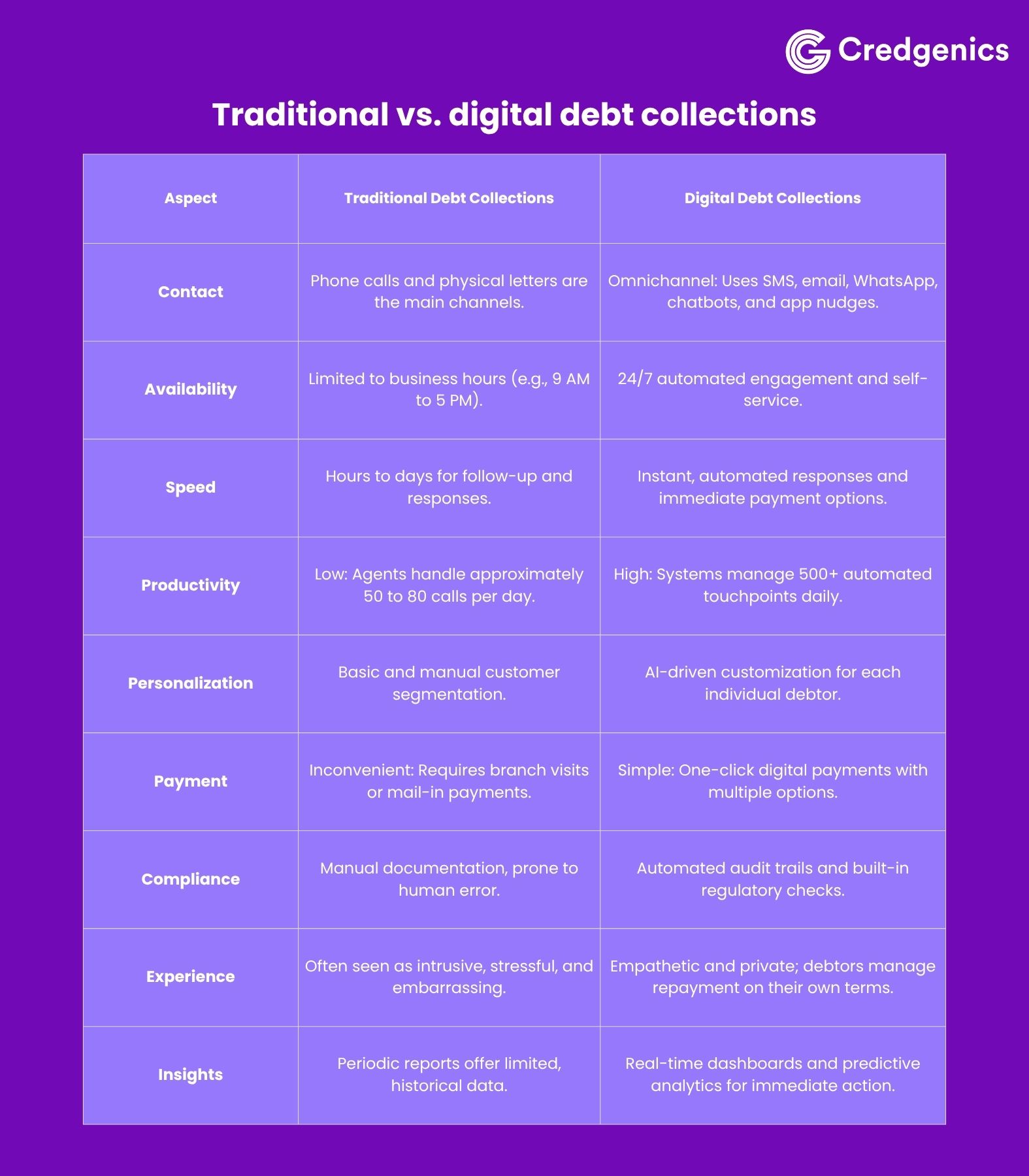
Traditional vs. digital debt collections: A quick analysis
Key differentiators from traditional methods
Proactive rather than reactive: Instead of waiting for accounts to become severely delinquent, digital systems identify early warning signals and intervene before defaults escalate. This proactive approach is a key reason digital debt collection recovery rates outperform traditional models.
Personalization at scale: While traditional methods apply one-size-fits-all strategies, digital platforms analyze individual borrower data to customize communication, timing, messaging, and channels for each case.
Continuous optimization: Digital systems learn from every interaction, continuously refining their strategies based on what works and what doesn’t, creating a self-improving collection process that sustains faster debt recovery with digital collection over time.
How digital debt collection works (end-to-end)
Understanding the digital debt collection workflow reveals how technology prevents defaults before they happen and optimizes recovery at every stage, from prediction to resolution.
1) Predictive Risk Detection & Pre-Due Intervention
Before accounts become overdue, AI continuously monitors spending patterns, repayment behavior, credit score performance, income volatility, and engagement history to identify borrowers likely to miss upcoming EMIs. Early warning systems trigger personalized pre-due nudges, flexible reminders, awareness campaigns and alternative repayment options—preventing slippages before they start and directly improving digital debt collection recovery rates in early buckets.
2) Smart Risk Classification
When accounts enter soft or hard delinquency buckets, AI evaluates risk parameters and classifies borrowers into three distinct paths:
- Self-cure borrowers: Minimal, optimized reminders
- Digital-assisted support needed: Guided payment options and flexible EMI restructuring
- High-risk requiring escalation: Human agents, field collectors, or legal workflows
This segmentation is central to how digital debt collection improves recovery rates, by matching the right effort to each borrower’s risk profile.
3) Intelligent, Multi-Channel Outreach
AI identifies the optimal channel, timing, language, and message format for each borrower based on their profile. Outreach is delivered via WhatsApp, SMS, email, voicebots, chatbots — with personalized content that reflects exact amounts due, available options, and tone calibrated to borrower intent and past engagement.
For digital debt collection for banks and NBFCs, this intelligent and multichannel capability ensures high coverage across large and diverse portfolios. For digital debt collection for fintech lenders, it supports high-frequency, fully digital interactions aligned with mobile-first customers.
4) Progressive Escalation Path
- Digital channels first → Automated reminders and digital-assisted support
- Human intervention when needed → Calling teams with contextual scripts guide borrowers through resolution steps
- Field & legal escalation → Field collectors for visits and pre-legal/legal workflows for complex or high-risk cases
This structured path balances empathy and firmness, enabling faster debt recovery with digital collection while keeping costs in control.
5) Frictionless Payment Options
Borrowers can pay instantly through UPI, cards, net banking, or wallets. They can also split payments into EMIs, pay partially, or schedule future payments. All transactions update in real time, providing transparency and reducing friction.
By making it extremely simple to pay, lenders see higher promise-to-pay conversions and better digital debt collection recovery rates across product lines.
6) Continuous Optimization
Live dashboards track channel effectiveness, optimal timing, and message performance per segment. AI models update automatically to improve recovery rates and reduce defaults continuously across all buckets.
This feedback loop is essential for lenders that want to standardize how digital debt collection improves recovery rates and scale best practices across teams, geographies, and product portfolios.
How digital-led collections transform lender performance
Stronger and earlier recoveries
Digital journeys help lenders engage borrowers proactively, increasing the share of accounts that get resolved before they become problematic and lifting overall recoveries versus call-only models. As a result, digital debt collection recovery rates improve from early-stage buckets all the way to write-off prevention.
Faster resolutions with less friction
Automated, contextual nudges across preferred digital channels keep borrowers informed and responsive, shortening the time from first contact to commitment and final resolution. For lenders, this translates into faster debt recovery with digital collection and improved cash flows.
Lean, scalable cost of collections
Self-service flows, smart segmentation, and automated workflows reduce the need for manual calling and field effort, lowering cost per case while allowing teams to handle far more accounts.
A borrower experience that builds trust
Private, respectful, and self-directed repayment options across chat, messaging, email, IVR, and bots make it easy for borrowers to stay on track, improving engagement and preserving long-term relationships.
Tighter control on risk and compliance
Policy-led, fully traceable digital journeys with centralized dashboards and standardized workflows make it easier to monitor collections quality and enforce compliance.
This combination of higher recoveries, lower costs, and better experience is precisely how digital debt collection improves recovery rates in a sustainable, compliant manner.
Recommended Read | Lender’s guide for crafting borrower-centric repayment solutions
Why Credgenics
Credgenics is the AI-powered, end-to-end full stack platform for digital debt collection, uniting strategy, analytics, omnichannel outreach, payments, and legal workflows in one system.
With Credgenics, lenders can:
- Predict who to contact, what to say, and when to act using explainable AI
- Launch GenAI-assisted outreach that stays within brand and compliance guardrails
- Offer seamless payments across UPI, cards, wallets, and net banking
- Track performance with real-time dashboards
- Run policy-driven operations
- Move from manual follow-ups to precise, empathetic recoveries at scale
Whether you are designing digital debt collection for banks and NBFCs with large-scale operations or implementing digital debt collection for fintech lenders that run fully digital journeys, Credgenics helps standardize best practices and uplift digital debt collection recovery rates across the board.

FAQs
What is digital debt collection, and how does it work?
Digital debt collection is the use of technology, automation, and data analytics to recover overdue payments through digital channels like SMS, WhatsApp, email, IVR, and voicebots.
It combines AI/ML algorithms, omnichannel communication, and self-service payment options to deliver faster recoveries with minimal human intervention. Instead of relying solely on phone calls, digital debt collection creates personalized, automated journeys that engage borrowers on their preferred channels at optimal times—directly improving digital debt collection recovery rates across delinquency stages.
What are the main benefits of digital debt collection?
The key benefits of digital debt collection include:
- Higher digital debt collection recovery rates
- Faster payment resolution
- Reduced costs
- Better customer experience
- 24/7 availability
- Improved compliance
- Real-time insights
Together, these benefits explain how digital debt collection improves recovery rates while strengthening borrower relationships.
How do AI and machine learning improve debt collection outcomes?
AI and machine learning enhance digital debt collection through several mechanisms:
- Predictive analytics: Identifies which borrowers are most likely to pay or default, optimizing collection prioritization
- Sentiment analysis: Adjusts communication tone to maximize impact and receptiveness
- Best-time prediction: Determines the optimal time and channel to contact each borrower based on behavioral patterns
- Risk scoring: Automatically categorizes accounts into different risk tiers for appropriate handling
- Promise-to-pay prediction: Forecasts which borrowers are most likely to commit to repayment
- Personalization: Customizes messaging, offers, and payment plans for individual debtors
- Continuous learning: Systems improve over time as they process more data and interactions
For lenders, these capabilities deliver faster debt recovery with digital collection and more reliable, predictable outcomes.
How do personalized payment links work in digital debt collection?
Personalized payment links are secure and unique URLs that are sent to borrowers to streamline the credit repayment process. Each link is customized with the exact amount due and offers multiple payment options, including cards, net banking, and UPI. Borrowers can click the link and complete payment in seconds.
By reducing friction in the last mile, personalized links contribute meaningfully to higher digital debt collection recovery rates.
How can digital debt collection improve customer experience?
Digital debt collection enhances customer experience by:
- Offering flexibility: Multiple payment options, EMI splits, and schedule options reduce stress
- Providing convenience: 24/7 availability means borrowers can pay anytime, anywhere
- Using empathetic communication: Personalized, contextual messaging respects borrower circumstances
- Enabling self-service: Borrowers control their interactions without mandatory agent contact
- Delivering instant gratification: Real-time payment confirmation and settlement updates
- Respecting preferences: Systems communicate through the borrower’s preferred channel
- Reducing friction: Minimal steps to complete payment reduce abandonment
This empathetic, digital-first experience is central to how digital debt collection improves recovery rates without damaging brand equity.
Is digital debt collection suitable for all types of lenders?
Yes, digital debt collection is beneficial for all types of lenders, including banks, NBFCs (Non-Banking Financial Companies), fintech lenders, and credit card companies.
The scalability of digital systems makes them particularly effective for lenders managing large borrower bases, while the personalization capabilities serve niche lenders well. Whether managing retail credit, consumer loans, SME lending, or credit cards, digital debt collection adapts to different lending products, borrower profiles, and regulatory environments.
This makes digital debt collection for banks and NBFCs and digital debt collection for fintech lenders equally relevant, and crucial for improving digital debt collection recovery rates at scale.