


Banks, NBFCs, insurers and other financial institutions have spent the last few years adding AI wherever it looked useful: a chatbot in the app, a voicebot on the support line, analytics on top of the CRM. Each tool does its own job reasonably well. The trouble starts in the gaps between them.
A 2026 study by Genesys and Dun & Bradstreet surveyed 104 senior leaders across Indian banking, insurance, NBFCs, fintech and wealth management. It found that 69% see data quality and fragmentation as their main barrier to modernisation. Customers feel that barrier directly, even though they never see the systems behind it.
What disconnected AI looks like to a customer
Take a borrower who misses an EMI because a payment failed. An automated reminder goes out. The borrower calls support and explains what happened. A couple of days later, the IVR collections system calls and asks for the same payment, because it knows nothing about the earlier conversation.
No tool failed here. Each one did exactly what it was set up to do. The customer simply ended up with three separate conversations about one problem. The same pattern shows up in sales follow-ups, onboarding, servicing and renewals.
This matters beyond annoyance. Loans and advances were the largest complaint category at the RBI Ombudsman offices in 2024-25, with about 86,670 complaints, roughly 29% of the total (RBI, Annual Report of the Ombudsman Scheme, 2024-25). Not all of these come from disconnected systems, but servicing and grievance handling are where the gaps show up first.
Silos cost banks and lenders in four ways:
- Repetition. When systems don’t share history, customers repeat themselves and agents spend the first few minutes piecing the story together.
- Mixed messages. Each tool has its own script, priorities and follow-up timing, so the customer hears different things from different places.
- Lost context at handoff. A chatbot may recognise a complicated issue but be unable to pass the details on to a human agent.
- Weak oversight. When records sit in separate systems, it is harder to track how often customers are contacted, what was said and whether it met regulatory requirements.
Adding more AI doesn’t automatically make the experience better. The tools need to share what they know.
Why you need a layer that connects them
A connected customer experience platform sits across channels and keeps context in one place. Rather than treating each query as a separate event, it decides the next step from the customer’s data, stated intent, stage in the journey and the lender’s own business rules.
Here is what the same logic does at each stage of the customer lifecycle:
- Sales. A prospect who enquires after hours is kept warm on WhatsApp or SMS and handed to the right agent the next morning, with the conversation already attached.
- Onboarding. A customer who stalls on a required step gets a nudge on their preferred channel.
- Servicing. Routine queries are resolved through self-service, and complex ones reach an agent with the history intact.
- Collections. A borrower who says they will pay on Friday has that commitment recorded and the right follow-up triggered, while one who raises a dispute goes to the right human team.
In practice, a layer like this should let a bank or NBFC:
- keep one view of customer history and intent across channels,
- coordinate voice, chat and digital journeys using defined rules and customer signals,
- hand conversations to human agents with context, so customers don’t start again, and
- see how journeys are performing, including quality and compliance, in one place.
The aim isn’t to replace the specialist tools a business already uses. It is to make them work as one journey.
What it looks like when it works
Customers don’t think in departments. To them, the bank or lender is one organisation, and they expect it to know who they are and what they are asking about.
Good design starts with knowing when AI should step back. Automation handles routine queries well. A disputed charge, a sensitive complaint or a complicated service problem usually needs a person, and the handoff should carry the full context with it. The same applies across the lifecycle: sales, onboarding, servicing, payment reminders, collections and grievance handling all affect one another, so a change in one should be visible to the others.
How Credgenics CXM connects customer journeys
Credgenics CXM is built for the whole BFSI customer lifecycle, not one function. It covers three areas: Digital CX Orchestration, the Sales Centre of Excellence and Service Excellence, and draws on the experience Credgenics built running high-volume, regulated conversations in collections.
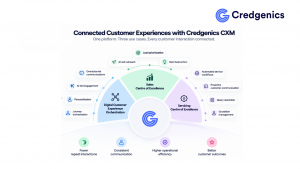
The platform brings together Prix Voice AI agents and chatbots, predictive engagement, workflow automation, the CG Guide knowledge management bot, and automated quality assurance through speech analytics. The aim is to help teams personalise interactions, automate routine engagement and move smoothly between AI and human agents.
The same connected workflows apply at each stage. Sales teams get warm leads handed over with context. Service teams get live prompts and knowledge support during the conversation. Collections teams can bring digital reminders, voice calls, telecalling, field visits and resolution workflows together. In each case, the customer’s intent and history guide the next step, with human oversight in place.
The goal isn’t to automate more conversations. It is to cut repetition, keep engagement consistent and give teams a clear view of how each journey ends.
Explore Credgenics CXM to see how connected AI and omnichannel orchestration can support more consistent customer journeys.

Frequently asked questions
What is a CXM platform in BFSI?
A customer experience management (CXM) platform helps banks, NBFCs and other financial institutions coordinate customer interactions across channels, teams and workflows. It brings AI-led engagement, customer context, automation and human support together so journeys stay consistent.
Why can too many AI tools hurt customer experience?
When AI tools work in silos, they don’t share interaction history, intent or follow-up status. Customers end up repeating themselves, receiving inconsistent messages and waiting longer for a resolution.
How does AI improve customer experience in banking?
It can predict customer needs, answer routine queries, personalise communication, support agents and coordinate next steps. How well it works depends on data quality, integration, governance and how workflows are designed.
What is the difference between a chatbot and a CXM platform?
A chatbot handles conversations in a chat interface. A CXM platform coordinates journeys across channels, AI tools, human teams and business workflows, so each interaction contributes to a wider outcome.