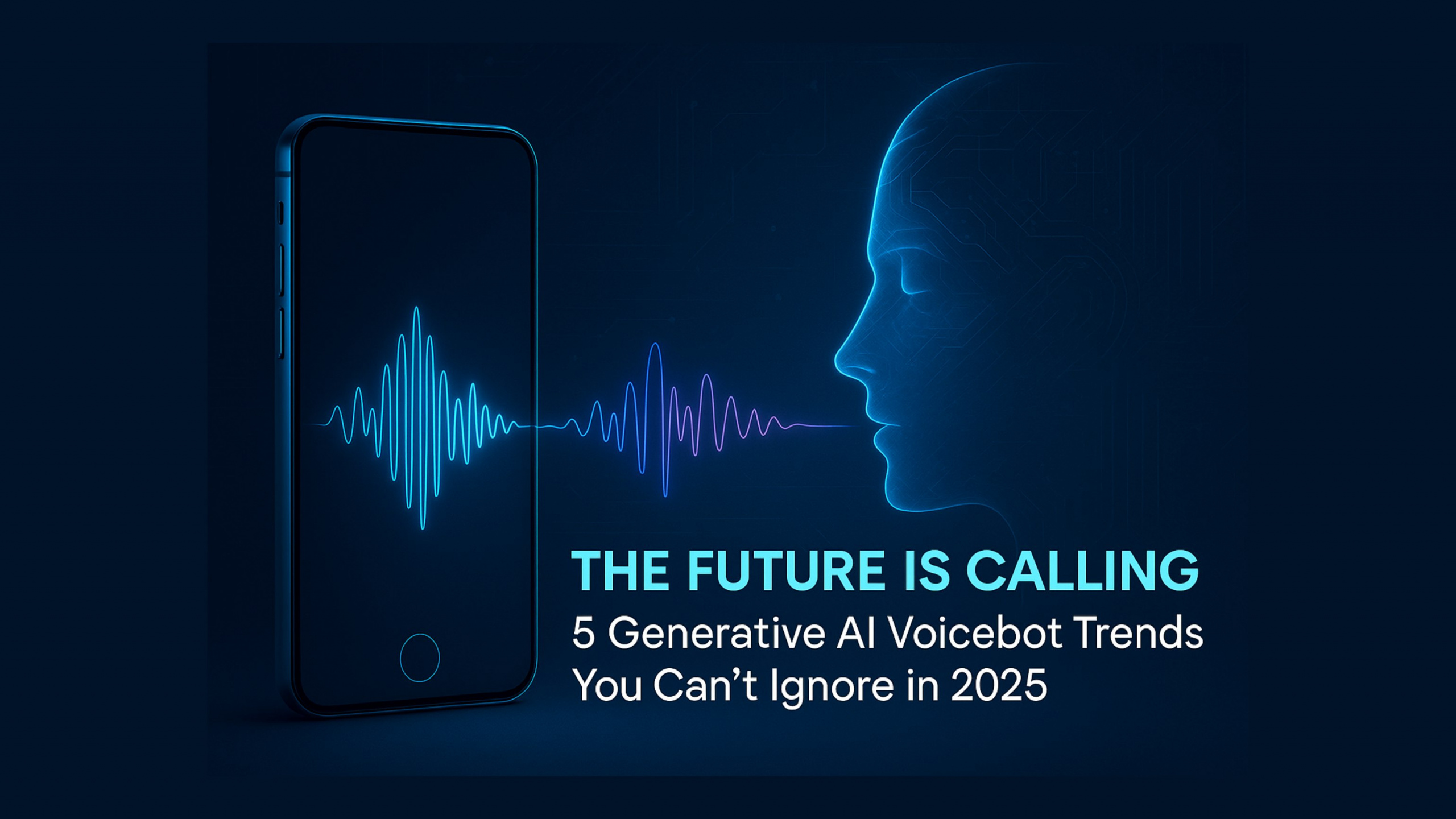
Generative AI is no longer a futuristic buzzword; it is getting firmly entrenched in processes, as a key enabler. Literally. The rise of AI voicebots in 2025 is rewriting the rules of customer engagement, communication, and automation. These voice-driven digital assistants are more human, more intelligent, and more proactive than ever before.
So if you are wondering, “What are the latest trends in voicebots?” or “How will AI change customer calls?”, you are in the right place. Let’s explore the top five Generative AI voicebot trends shaping 2025 and how they are redefining the conversational AI future.
The voice AI revolution is here
According to McKinsey’s 2025 tech trends report, conversational AI is among the top three areas where businesses are increasing investment, signaling a fundamental shift in how organizations view voice technology. Surveys also suggest that 70% of businesses plan to adopt voice AI technology by the end of 2025, making this the year when voice AI transitions from novelty to necessity.
But what’s driving this unprecedented adoption? The answer lies in the perfect storm of technological advancement, economic pressure, and evolving customer expectations.
1. Emotionally intelligent voicebots for sentiment-driven interactions

The future of automated customer service lies in emotional intelligence. Today’s generative AI voicebots are equipped with sophisticated sentiment analysis capabilities that can detect frustration, satisfaction, confusion, or urgency in a customer’s voice and adjust their responses accordingly.
This emotional awareness transforms customer interactions from transactional exchanges to meaningful conversations. When a voicebot can recognize that a customer is stressed about a financial situation, it can adjust its tone, offer additional support options, or escalate to human agents when appropriate.
Such emotional intelligence is crucial for the evolution of automated customer service, especially in sensitive industries like finance, healthcare, and insurance.
2. Hyper-personalized conversations powered by generative AI

The keyword for 2025 is personalization. With the evolution of Generative AI, voicebots can now craft responses that feel custom-made. They analyze user data, past interactions, behavioral patterns, and even payment history to tailor each conversation uniquely.
Modern generative AI voicebots:
- Remind borrowers of pending EMIs
- Suggest flexible repayment options
- Follow up with payment links—all in real-time
This level of AI in communication ensures higher engagement, faster resolutions, and fewer escalations. Businesses implementing personalized voice AI are seeing dramatic improvements in customer satisfaction and operational efficiency.
3. Real-time multilingual support and language switching

One of the most exciting Generative AI voicebot trends is the seamless multilingual capabilities. In a country as linguistically diverse as India, and globally, this is a breakthrough.
Advanced voicebots can now switch languages mid-conversation, effectively breaking down communication barriers. This functionality is especially impactful in multicultural markets and global business settings. Modern AI voicebots can detect a customer’s preferred language and adapt their responses in real time, delivering truly inclusive and personalized customer service.
Companies that invest in multilingual voice AI are better positioned to reach broader audiences and provide a more empathetic, human-like customer experience. After all, people are far more likely to engage when spoken to in their native language.
4. Seamless automation from call to conversion

Voicebots are no longer just for handling FAQs. In 2025, they’re end-to-end automation engines. Whether it’s collecting payments, scheduling calls, or routing to human agents, everything happens in a single interaction.
Modern generative AI voicebots can perform complex tasks during conversations, such as processing payments, scheduling appointments, updating customer records, and even sending follow-up communications. For businesses, it means a massive reduction in contact center costs and a sharp increase in successful resolutions.
5: Next-gen voice models: powering truly human conversations

Generative AI voicebots in 2025 are no longer just smart—they are conversationally intelligent. Thanks to the seamless fusion of advanced models: Large Language Models (LLM), Text-to-Speech (TTS), and Speech-to-Text (STT).
These next-gen voice models form a powerful stack that understands context, generates thoughtful replies, and delivers them with natural tone, empathy, and emotional nuance. LLMs serve as the conversational brain, enabling flexibility, memory, and fluid dialogue. TTS brings voice to life with realistic expression and regional character, while STT ensures accurate understanding even in noisy, real-world environments.
Together, they create voicebots capable of handling the complexity of real human interaction, whether it is resolving a payment issue, offering tech support, or simply making conversation feel effortless.
The business impact: Beyond cost savings
While the economic benefits of voice AI adoption are significant, businesses can automate manual, repetitive queries through AI-powered voicebots. And the true value lies in the enhanced customer experience and operational capabilities they provide.
AI-powered voice agents allow businesses to be available to their customers 24/7 to answer questions, schedule appointments, or complete payments, which creates unprecedented levels of accessibility and convenience. This always-on availability is becoming a competitive advantage in markets where customer expectations continue to rise.
Conclusion: The voicebot revolution is here
As we move through 2025, businesses that embrace generative AI voicebot trends will strengthen customer relationships, streamline operations, and gain a decisive competitive edge. The key lies in setting clear objectives, choosing the right technology partners, and deploying solutions that align with both business goals and customer expectations.
From reducing operational costs and enhancing customer satisfaction to enabling scalable, multilingual support, the trends driving voice AI today offer unprecedented opportunities for innovation and growth. The future of customer service automation is conversational, intelligent, and deeply personalized.
Swara, the Nextgen Collections AI Assistant by Credgenics, is transforming debt collections with empathy, multilingual fluency, and AI-powered precision. Designed to understand rather than just respond, Swara is helping lenders, fintechs, and enterprises scale borrower communication with empathy and precision. With over 1.5 million positive intents generated and up to 80% reduction in contact center costs, it proves that voicebots powered by generative AI are a transformative force in customer engagement.

FAQs
1. What are the latest trends in voicebots in 2025?
The latest generative AI voicebot trends in 2025 include emotionally intelligent interactions, hyper-personalization, real-time multilingual support, end-to-end automation, and a focus on responsible AI usage. Today’s AI voicebots are becoming smarter and more natural. They can detect emotions, conduct personalized conversations, switch languages seamlessly, and guide customers smoothly from the initial inquiry to final resolution.
2. How will AI change customer calls in the future?
AI will make calls smarter, shorter, and more human-like by understanding intent, analyzing emotion, and resolving queries without the need for human escalation. With advanced voice AI technology, businesses can offer 24/7 availability, multilingual support, and personalized interactions that feel more human than ever.
3. What is the future of automated customer service with generative AI?
Modern generative voice AI applications can analyze user data, past interactions, and behavioral patterns to create custom-tailored responses. These systems can remind customers of pending payments, suggest flexible options, and provide real-time solutions while maintaining empathy and understanding. The technology enables end-to-end automation that reduces contact center costs while dramatically improving customer satisfaction and resolution rates.
4. What makes generative voice AI applications different from traditional voicebots?
Generative voice AI applications differ from traditional voicebots through their advanced emotional intelligence, personalization capabilities, and seamless integration of multiple AI technologies. Unlike basic automated systems, these voicebots use sophisticated sentiment analysis to detect customer emotions and adjust their responses accordingly. They leverage voice AI technology that combines LLMs for conversational intelligence, TTS for natural expression, and STT for accurate understanding in real-world environments.
5. What makes Credgenics Swara unique among other AI voicebots?
Swara combines generative AI with deep integration into debt collection workflows, multilingual fluency, and real-time payment capabilities.